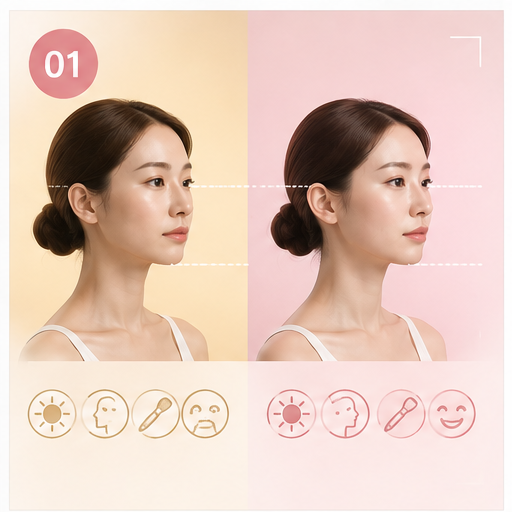
6 Tips for Viewing Before and After Photos of Beauty Treatments in Korea
In Korea, the options for skin care and plastic surgery have expanded, making it important to check before-and-after photos.
When looking at before-and-after photos, it's essential to consider the shooting conditions, timing, and accompanying explanations rather than just whether they look pretty.
The key is to find cases that resemble my own face and not to make decisions based solely on photos.
Why should we ‘read’ before-and-after photos?
Recently, as the number of foreign visitors receiving cosmetic medical treatments in Korea has increased, it has become common to refer to before-and-after photos (case photos) during the selection process.
However, if you judge before-and-after photos solely based on the impression of ‘being pretty,’ it can lead to results that differ from your expectations.
Photos are just reference materials; checking the conditions and context (shooting environment, time, treatment information) helps in making informed judgments.
1) Check if the Before and After photos are taken under the same conditions
The first thing to look at is whether the Before and After photos were taken under the same conditions.
Even small differences in lighting, angle, makeup, and expression can make the results look better or different.
If possible, refer to photos taken with the same lighting, angle, and expression.
- Check if the lighting has changed (brightness, shadows)
- Check if the angle of the face/head direction is the same
- Check if the makeup is consistent
- Check if the expressions (neutral/smile) are the same
2) Find examples that are similar to me rather than the 'most beautiful cases'
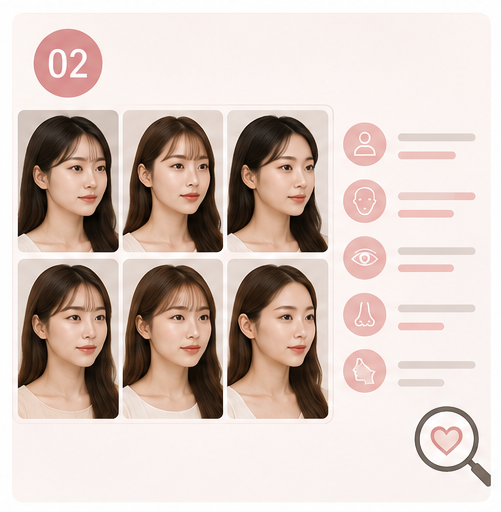
What is important in the Before and After photos is not to find the most strikingly good case, but to check if it is similar to my conditions.
The more similar the age group, concern area, and eye/contour characteristics are, the easier it is to realistically imagine the post-procedure appearance.
Additionally, since photos that only show specific areas make it difficult to assess the overall balance of the face, it is advisable to check materials that show the facial harmony as well.
- Cases with a similar age group (e.g., 30s, 40s, etc.)
- Cases with similar concerns (sagging, nasolabial folds, etc.)
- Cases with similar eye characteristics (single eyelid/double eyelid, etc.)
- Cases with similar facial and skeletal features (such as a square jaw)
- Don't just look at partial photos; consider the overall impression and harmony as well.
3) Check when the photo was taken (timing of the shoot)
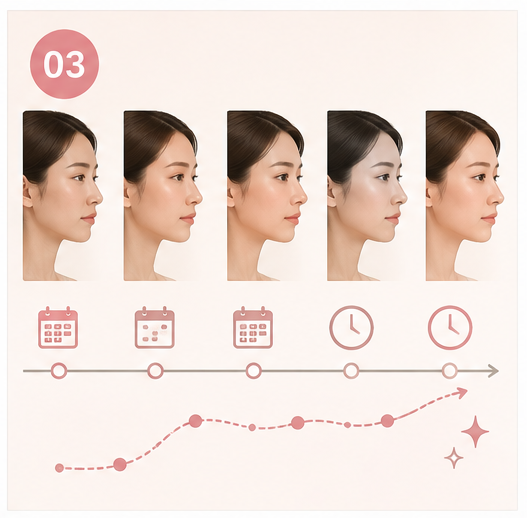
When looking at before-and-after photos, it is essential to confirm the timing of the shoot. Even with the same procedure, the appearance can differ between 'immediately after' and 'after some time has passed.'
As shown in the original text, the impression can change depending on the timing, such as on the same day, 1 week, 1 month, 3 months, or 6 months.
Additionally, some procedures may take time to stabilize, and surgeries may require a longer perspective for completion.
- Check the timing notation: same day/1 week/1 month/3 months/6 months
- Lifting: It may take several months to stabilize (as mentioned in the original text)
- Facial contouring and nose surgery: It may take 6 months to 1 year for completion (as mentioned in the original text)
- If possible, also refer to long-term follow-up photos (the original text mentions that 2-3 years of follow-up is rare)
4) Assess whether only 'good cases' have been posted
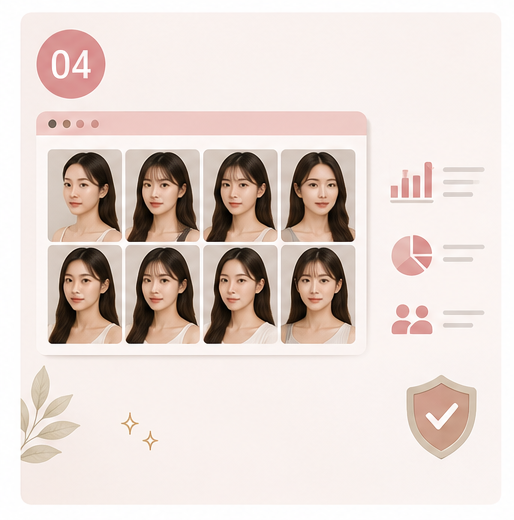
If the number of posted cases is small or if similar types are repeated, it is advisable to take a closer look.
If a wide range of ages, concerns, and procedure details are presented, it may indicate the experience of handling various situations.
Also, even if not all information is publicly available online, some places may have more materials to show during consultations, so you can inquire whether they can show cases similar to your conditions.
- Is the number of cases not excessively small?
- Check if similar cases are not just repeated
- Check if the range of age/concerns/procedures is broad
- Inquire about the possibility of confirming similar cases during the consultation
5) Don't just look at the photos, but also check the 'explanatory information'
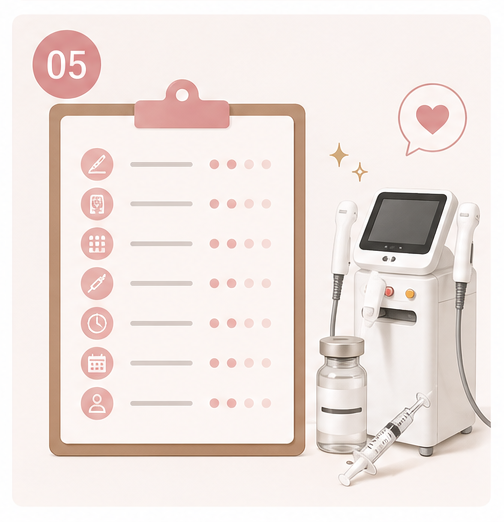
Good before-and-after photos often include not only the images but also the procedure information organized together.
By checking the explanatory items, you can understand conditions that are difficult to discern from photos alone, making it easier to determine if it’s the right choice for you.
In particular, explanations about the recovery process or progress help in understanding 'how the changes occur'.
- Procedure details
- Devices used
- Number of shots (if indicated)
- Medications used (if indicated)
- Downtime (if indicated)
- Explanation of the progress after surgery/procedure
6) Do not make decisions based solely on before-and-after photos (checklist)
Before-and-after photos are useful, but it is not recommended to finalize your choice based solely on them.
As presented in the original text, factors such as the experience of the medical staff, thoroughness of consultations, aftercare, and language support should also be checked to increase overall satisfaction.
Ultimately, the key is not whether the photos are pretty, but whether I can concretely imagine what it would be like when I undergo the procedure.
- Check the experience/performance information of the medical staff.
- Is the consultation sufficiently thorough?
- Check the details of aftercare.
- Check for language support such as Japanese.
- (As mentioned in the original text) Refer to actual user reviews/ratings, but do not rely solely on a single piece of information.
Frequently Asked Questions (FAQ)
Can I just look at 'partial photos (only nose/eyes)' for before and after?
The original text mentions that it is difficult to assess the overall balance of the face with only partial photos. It is helpful to look at materials that allow you to see the overall harmony if possible.
What is the first thing to check in the before and after photos?
The priority is to check whether the Before and After are under the same conditions (lighting, angle, makeup, expression). If the conditions differ, the results may appear better or different.
Why is the timing of the photos important?
According to the original text, the appearance can change depending on the timing, such as the same day, 1 week, 1 month, 3 months, or 6 months. Some procedures may take time to stabilize, or surgeries may require a longer period to see the final results.
Can I choose based on just the before and after photos if they look good?
The original text does not recommend making decisions based solely on before-and-after photos. It is also advisable to check the experience of the medical staff, the thoroughness of the consultation, aftercare, and language support.
This content is intended for general informational purposes, and the details may vary based on individual conditions. Please consult a medical professional for an accurate diagnosis and treatment plan.